Wait… You Can Put Meat in a Jar and Leave It on the Shelf?
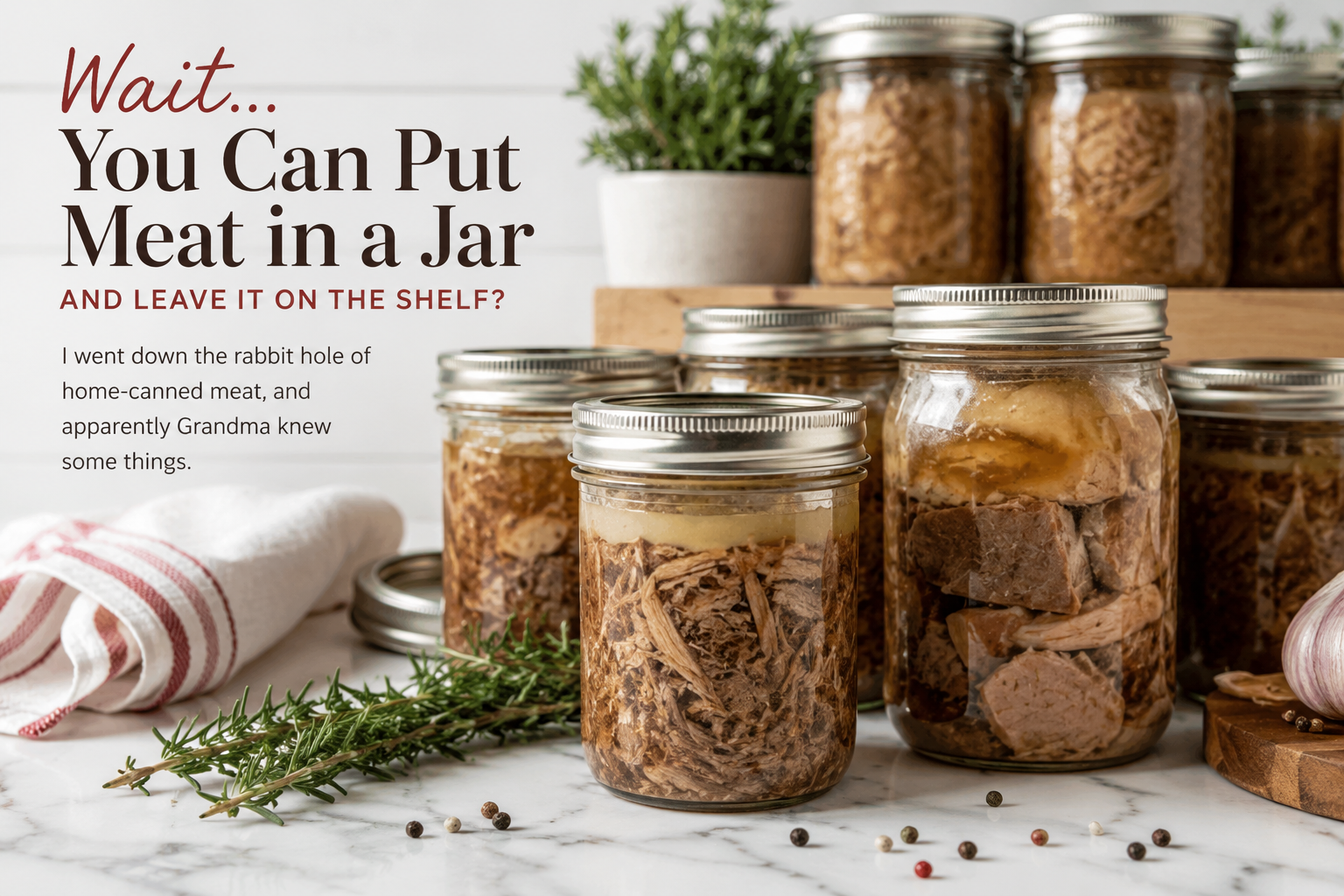
Let me start by saying this:
I do not can meat.
I have never canned meat.
And until recently, if you handed me a Mason jar containing chunks of beef that had been sitting in somebody's pantry for eight months and said, “Go ahead, Chef, it's good,” I would have had several follow-up questions.
Because somewhere along the way, most of us learned a very simple rule about meat:
Keep it cold.
Refrigerate it. Freeze it. Cook it. Don't leave it sitting on the counter.
So the idea that you can put beef, pork, chicken or venison into a glass jar, process it, put that jar on a pantry shelf and come back months later sounds like the beginning of either an excellent lesson in food preservation…
…or an episode of Things Chef David Will Not Be Participating In.
But then I started reading.
And, well…
Apparently this is a thing.
Not an internet-hack thing. Not a “my cousin has been doing it for 30 years and nobody has died yet” thing.
Actual food preservation.
So naturally, I went down the rabbit hole.
First Question: Is Canning Meat Actually Safe?
Yes.
But there is a very important asterisk attached to that yes.
Home-canned meat can be safely prepared when established pressure-canning procedures are followed. Meat, poultry, fish and seafood are considered low-acid foods, and the CDC says pressure canning is the recommended home-canning method for low-acid foods.
Low Acid
Meat does not have enough natural acidity for ordinary boiling-water canning.
Pressure
Pressure canning allows processing temperatures above normal boiling-water temperature.
Time
Tested processing times matter. This is not a “looks done to me” situation.
Altitude
Required pressure may need adjustment depending on elevation.
This isn't:
Cook some chicken.
Put it in a cute Mason jar.
Pop the lid on.
See you at Thanksgiving.
Absolutely not.
We're talking about a controlled preservation process involving the correct equipment, pressure, processing time, jar size and adjustments for altitude.
And this is where canning starts looking less like regular cooking and more like food science.
“Taste it. Adjust it. Throw in more garlic.”
Pressure canning apparently responds:
You will follow the directions.
And I respect that.
Why Can't I Just Boil the Jars?
This was one of my first questions.
If boiling water gets hot, and heat kills bacteria, why isn't a big pot of boiling water enough?
Water-bath canning works for properly prepared high-acid foods, but meat doesn't have enough acidity to provide that same protection.
The concern is Clostridium botulinum, the bacterium associated with botulism.
Its spores can survive ordinary boiling temperatures. In the right conditions—low oxygen, low acidity, sufficient moisture and an appropriate temperature—the spores can grow and produce botulinum toxin.
A sealed jar of improperly processed low-acid food can provide exactly the sort of environment we're trying to avoid.
That's why pressure matters.
A pressure canner allows temperatures above normal boiling-water temperature to be reached during processing.
“This is not the moment to say, ‘I've always done it this way.’”We’re still using the pressure canner.
And Yes, We Need to Talk About Botulism
Here's the part that makes people nervous.
Botulism is rare, but it is extremely serious.
Botulinum toxin cannot be reliably detected by sight, smell or taste. According to the CDC, even tasting a small amount of contaminated food can be dangerous.
Which means this is one occasion where:
“Let me taste it and see if it's still good.”
is NOT our food-safety strategy.
If you don't know whether a home-canned food was processed safely, don't taste-test your way to an answer.
That little sniff we all do?
Not helping us here.
So What Meat Are People Actually Canning?
This surprised me too.
The National Center for Home Food Preservation provides tested recommendations for things including beef, pork, lamb, veal, venison and other meats, along with separate guidance for poultry, seafood, stocks and certain meat-containing preparations.
And meat can sometimes be processed using either a hot pack or raw pack, depending on the tested procedure.
Hot Pack
Meat is partially cooked before being packed into the jar. NCHFP generally prefers hot packing for strips, cubes and chunks because of quality.
Raw Pack
Yep. It means what you think it means: raw meat goes into the jar before processing when the tested procedure specifically allows it.
Raw meat. Into the jar.
Yes. I stared at that section for a minute too.
How Long Are We Talking?
This is where I realized pressure canning isn't a quick little Sunday afternoon shortcut.
For tested procedures covering strips, cubes or chunks of meat, NCHFP lists the following processing times:
Processing Time: Meat Strips, Cubes & Chunks
NCHFP tested processing times. Pressure requirements vary by canner type and altitude.
Ninety minutes.
Not:
“It's been bubbling for a while. Looks done to me.”
No.
Ninety. Minutes.
And that's processing time—not permission to invent your own recipe and simply pressure-can it for 90 minutes.
The Pressure Canner Does Not Care About Your Creativity
This may be the hardest concept for cooks to accept.
You cannot assume that because one meat recipe has been safely tested, your completely different creation will behave exactly the same way inside the jar.
In normal cooking, creativity is usually rewarded.
Don't have thyme?
Use rosemary.
Want more garlic?
We're friends now.
Want to make the sauce thicker?
Go for it.
But safe canning processes are built around how heat moves through the food.
Change the food significantly and you've potentially changed how that food heats.
“Botulism does not care about branding.”So Chef David's Bourbon-Peach-Smothered Short Rib Pantry Surprise will have to wait.
What About an Instant Pot?
I know somebody was already thinking it.
“Chef, I've got that pressure setting on my multicooker.”
The CDC advises against relying on electric multicookers for pressure canning low-acid foods, even when an appliance has settings that sound like canning functions.
Pressure cooking and pressure canning are not automatically interchangeable processes.
✓ We're Talking About
- An appropriate pressure canner
- A current tested procedure
- Correct processing time
- Correct jar size
- Altitude adjustment where required
✕ Not This
- Guessing
- Water-bathing meat
- Random internet recipes
- “It looks done”
- Assuming pressure cooker = pressure canner
Your Instant Pot can go back to making dinner.
But Why Would Anyone Do This?
Now THIS is where my skepticism started turning into genuine curiosity.
Less Freezer Dependence
Pressure-canned meat provides another preservation option when freezer space is limited.
Bulk Buying
It can make sense for cooks preserving larger purchases, farm-raised meat or game.
Future Meals
Properly preserved meat can become the starting point for soups, stews, tacos, rice bowls and more.
Suddenly I understood why this method has survived generations.
This wasn't originally about having aesthetically pleasing Mason jars lined up for Instagram.
It was about preserving food.
And that's something cooks have been trying to master for thousands of years.
How Long Can It Sit There?
The CDC recommends canning only the amount you'll use within one year, unless the specific directions for the food say otherwise.
Jars should be labeled and dated and stored somewhere clean, cool and dark. For best quality, CDC guidance recommends storage between 50°F and 70°F.
“Shelf-stable doesn't mean immortal.”We're preserving dinner, not preparing supplies for 2147.
Rotate your pantry.
Use what you've preserved.
And date the jars.
Because six months from now, you are absolutely not going to remember whether that jar was from February or “sometime around when we had that cookout.”
Write the date.
And If the Jar Looks Suspicious?
This is where there will be no heroics.
Leaking, bulging, swollen, cracked or damaged containers, spurting liquid or foam, mold and unusual discoloration are reasons to discard canned food. But remember: the absence of visible warning signs does not prove improperly canned food is safe.
So our rule becomes beautifully simple:
This is not Chopped.
Nobody gets bonus points for bravery.
So…Would I Eat Home-Canned Meat?
Now we've arrived at the question I know somebody is going to ask.
Would Chef David actually eat it?
After doing the research?
If I knew it had been processed using a current, tested USDA/NCHFP procedure, with the correct pressure canner, processing time, jar size and altitude adjustment, I wouldn't consider the fact that the meat came from a jar inherently unsafe.
Would I eat a Mason jar of chicken somebody handed me
in a parking lot and said,
“Don't worry. I can all the time.”
We're going to have to know each other a little better.
Actually… No. 😂
Canning meat isn't inherently dangerous.
Improperly canning meat is dangerous.
That's an important difference.
When proper procedures are followed, pressure canning is an established method of preserving low-acid foods such as meat. But it's also one of those areas of cooking where precision isn't optional.
We talk a lot around here about learning to trust your instincts in the kitchen.
Taste your food.
Pay attention to your heat.
Learn what ingredients are telling you.
But being a confident cook also means recognizing the moments when instinct needs to step aside and science needs to take over.
Pressure canning is one of those moments.
So am I running out tomorrow to buy a pressure canner?
Let's not get carried away.
But am I now fascinated enough that I understand why generations of home cooks have jars of beef sitting confidently in their pantry?
Absolutely.
And if I ever decide to try it…
Meal After Meal.
— Chef David
🧪 A Food-Safety Note
This article is an exploration of home meat canning, not a step-by-step canning guide. Anyone interested in home canning should follow current, tested instructions from the USDA, CDC, National Center for Home Food Preservation, or their local Cooperative Extension service.
Processing requirements vary by food, preparation method, jar size, canner type and altitude.
Keep Building Kitchen Confidence.
Good cooking isn't just knowing what to do. It's understanding why it works. Explore practical techniques, flavor lessons and Meal After Meal Foundations inside Forks247 Kitchen Studio.
Explore Kitchen Studio →




Follow Us

A chef’s rule worth wearing.
The Taste It Before You Trust It T-Shirt takes one of the kitchen’s simplest lessons and turns it into a statement. Bold typography paired with a refined editorial accent gives the design a clean, modern look that feels just as good outside the kitchen as it does behind the line.
Finished with subtle Forks247 branding on the sleeve, this tee is made for cooks, food lovers, and anyone who knows the final decision should always come down to flavor.
Detail
Premium unisex fit 100% combed and ring-spun cotton Heather colors contain polyester Fabric weight: 4.2 oz./yd² (142 g/m²) Pre-shrunk fabric Side-seamed construction Shoulder-to-shoulder taping Forks247 sleeve branding Designed for everyday comfort
Taste it. Adjust it. Trust yourself.