
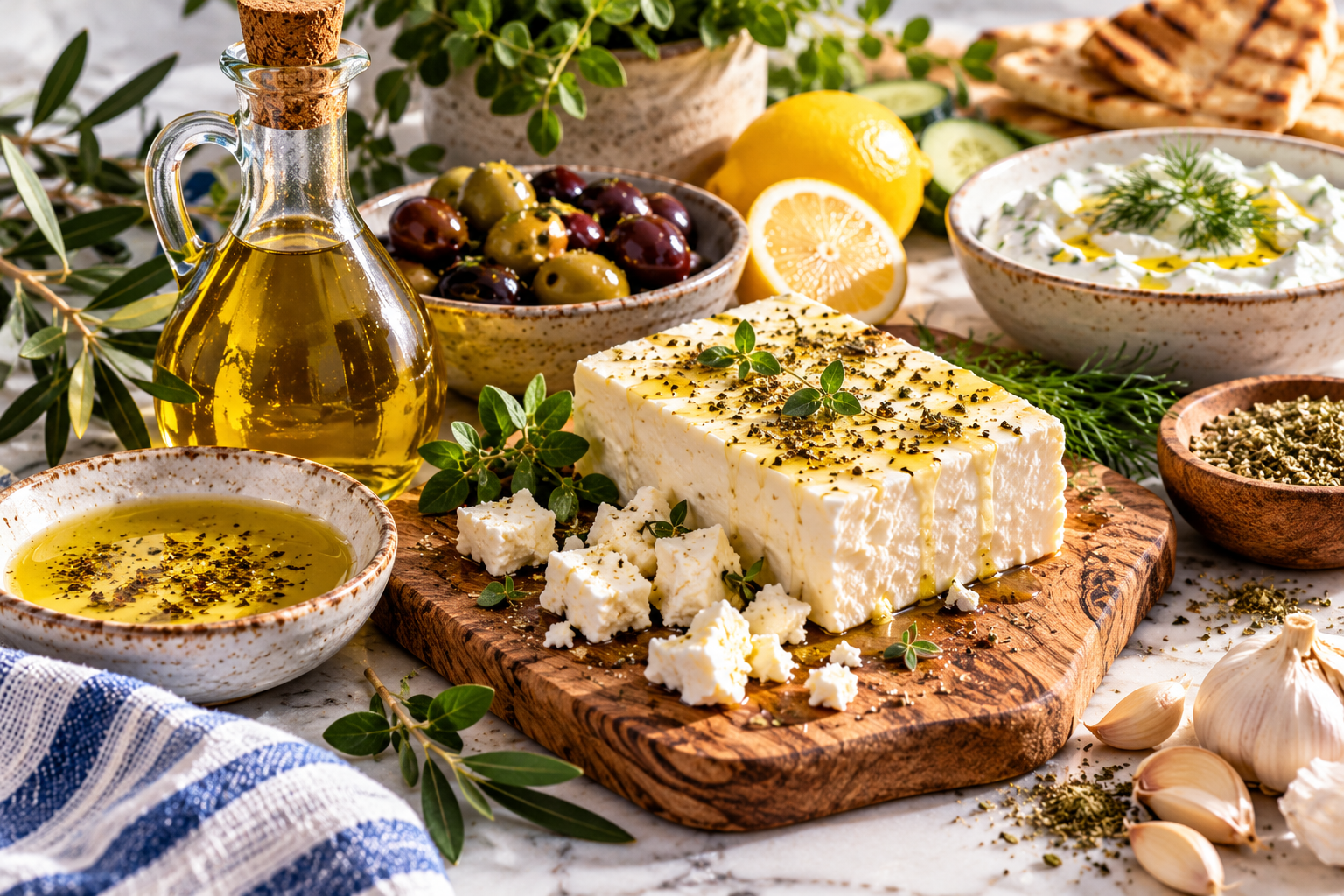
Two Mediterranean staples that deserve more attention in your kitchen.
Some ingredients are so familiar that we stop giving them the attention they deserve.
Olive oil gets poured into a skillet without a second thought. Feta gets crumbled over a salad, the container goes back into the refrigerator, and we move on.
But here's what I want you to consider.
What if that olive oil isn't just the fat you're using to cook?
What if it's the ingredient that brings the entire dish together?
And what if feta isn't simply something you sprinkle over vegetables, but an ingredient capable of bringing richness, acidity, and a beautiful savory character to everything from roasted vegetables to pasta sauces?
That's where cooking starts getting interesting.
In our first Around the Table feature, we explored the beauty of Greek cooking and its appreciation for simple, carefully chosen ingredients.
Now we're getting a little more hands-on. Let's talk about two ingredients that deserve a permanent place in your culinary toolkit: feta cheese and extra virgin olive oil.
Feta: A Little Cheese With a Lot of Personality
There's feta, and then there's really good feta.
If your only experience with this cheese comes from those little containers of dry, pre-crumbled pieces, I want you to try something different.
Buy a block of Greek feta packed in brine.
You'll notice the difference before you even start cooking.
The texture is moist and pleasantly crumbly. The flavor is tangy, distinctly salty, and rich without being especially heavy on the palate.
It's the kind of ingredient that can turn something ordinary into something memorable.
What Makes Real Greek Feta Different?
Feta has been part of Greek food culture for centuries, with cheese-making traditions stretching back to antiquity.
Today, Greek Feta PDO—Protected Designation of Origin—is produced according to specific standards and within designated regions of Greece.
It's made from sheep's milk or a combination of sheep's milk and no more than 30% goat's milk.
The cheese is salted and matured in brine for at least two months, helping develop its characteristic flavor and texture.
Why does that matter?
Because where an ingredient comes from, how it's produced, and what goes into making it all influence the finished product.
You may encounter other delicious white brined cheeses made from cow's milk or different milk blends. But they aren't necessarily the same as authentic Greek Feta PDO.
Understanding the distinction helps you shop with intention.
Why I Prefer Block Feta
For salads, whipped spreads, and many cooked preparations, I prefer feta sold in blocks, ideally with its brine.
First, you have more control over the texture. You can cut thick slices, break off rustic pieces, or blend it into something smooth and creamy.
Second, the moisture helps maintain the character of the cheese.
And third, it's simply more versatile.
Pre-crumbled feta is convenient, and there's nothing wrong with convenience when you need it. But when feta is meant to be one of the stars of the dish, block feta is worth seeking out.
Olive Oil: Not All Bottles Tell the Same Story
Let's clear something up.
The words extra virgin aren't simply marketing language designed to make one bottle of olive oil sound more expensive than another.
They describe a recognized quality classification.
Extra virgin olive oil is extracted from olives through mechanical or physical methods, without refining, and must meet specific chemical and sensory standards.
That includes a free-acidity limit of 0.8%, expressed as oleic acid, along with requirements for flavor and the absence of defined sensory defects.
Now, that doesn't mean you need to memorize laboratory standards before buying a bottle.
What matters in your kitchen is understanding that different olive oils bring different characteristics to food.
Some taste mild, smooth, and buttery. Others are grassy, green, peppery, or pleasantly bitter.
And those differences can influence the direction of an entire dish.
Extra Virgin, Virgin, and Regular Olive Oil
Extra Virgin Olive Oil
Made without refining and required to meet the highest virgin olive oil grade standards. It retains distinctive flavor and aroma and is excellent for dressings, finishing dishes, dipping, sautéing, and many roasting applications.
Virgin Olive Oil
Also extracted without refining, but meets a different quality grade. It may have a less refined flavor profile or slight sensory imperfections permitted within the grade.
Regular or Pure Olive Oil
Commonly consists of refined olive oil blended with virgin olive oil. It's generally milder in flavor, making it useful when you don't want a pronounced olive character.
And one more thing: light olive oil doesn't mean fewer calories.
It refers to a lighter flavor and color, generally resulting from refining.
Can You Actually Cook With Extra Virgin Olive Oil?
Absolutely.
There's a common misconception that extra virgin olive oil should only be used cold or drizzled over finished food.
That simply isn't true.
Quality extra virgin olive oil can be used for sautéing, roasting, and a wide range of everyday cooking methods.
Its suitability depends on factors such as temperature, oil quality, freshness, and the cooking technique.
As with any cooking fat, avoid overheating it to the point where it's smoking excessively or breaking down.
Here's how I approach it.
If I'm sautéing vegetables with garlic and herbs, I may use extra virgin olive oil because I want that flavor to become part of the dish.
If I'm preparing something with a very delicate flavor, I might choose a mild olive oil.
And if I'm finishing roasted vegetables, pasta, or grilled seafood, I'll often reach for an extra virgin olive oil with a little more personality.
That final drizzle isn't just about adding richness. It's about adding another layer of flavor.
How to Buy and Store a Better Olive Oil
You don't need to buy the most expensive bottle on the shelf.
But you should know what to look for.
Pay attention to freshness. A harvest date, when available, can tell you more about the oil's age than a beautiful label.
Choose protective packaging. Dark glass, tins, and other light-protective containers help preserve quality.
Buy what you'll actually use. Olive oil doesn't improve with age. A reasonably sized bottle that you'll finish while it's fresh is often a better purchase than a giant container sitting around for months.
Store it away from heat and light. That spot directly beside the stove might be convenient, but it isn't the best place for maintaining freshness.
And don't judge quality by color alone.
A deep green oil isn't automatically better than a golden one.
Taste, freshness, balance, and proper production matter far more.
Five Ways to Use Feta and Olive Oil Beyond Greek Cooking
Here's where I want you to have a little fun.
One of the best things about learning from another culinary tradition is discovering how those ingredients can fit into the food you already love.
You don't have to cook an entirely Greek-inspired dinner to appreciate feta and olive oil.
Sometimes all it takes is one thoughtful adjustment to a familiar recipe.
Give Roasted Vegetables a Beautiful Finish
Roasted vegetables are one of my favorite places to build layers of flavor.
Start with carrots, Brussels sprouts, broccoli, or sweet potatoes.
Roast until the edges develop some color and the natural sweetness comes forward.
Then, while they're still warm, finish with crumbled feta, a drizzle of extra virgin olive oil, and fresh herbs.
The contrast is what makes this combination work.
Warm, caramelized vegetables meet cool, tangy cheese. Rich olive oil carries the flavors while a little lemon zest adds brightness.
It's simple, but it doesn't taste ordinary.
Turn Feta Into a Creamy Pasta Sauce
Now this is one I think more home cooks should experiment with.
Feta doesn't have to stay cold, and it certainly doesn't have to be limited to salads.
Blend it with roasted garlic, extra virgin olive oil, and a little warm pasta water.
The result is a creamy, tangy sauce with a completely different personality from traditional Alfredo.
Feta doesn't melt into a perfectly smooth sauce the way some other cheeses do, so blending is the technique that brings everything together.
Add fresh herbs, sautéed spinach, roasted tomatoes, or grilled chicken, and you've built a satisfying meal.
Make Breakfast a Little More Interesting
Scrambled eggs, baked eggs, and vegetable frittatas all benefit from feta's salty, tangy flavor.
But don't just throw it in without thinking about the balance.
If you're making soft scrambled eggs, fold in a little feta toward the end so it softens without disappearing completely.
For a frittata, pair feta with spinach, caramelized onions, roasted peppers, or fresh herbs.
Finish with a small drizzle of olive oil before serving.
The richness of the eggs, salinity of the cheese, and freshness of the vegetables work beautifully together.
Build Marinades With More Intention
Olive oil is an excellent starting point for marinades, but oil alone doesn't create complexity.
Think about what each ingredient contributes.
Olive oil helps carry fat-soluble flavors from ingredients such as herbs and spices.
Lemon juice or vinegar brings acidity.
Garlic contributes savory depth, while herbs introduce aroma.
For grilled chicken, fish, pork, or vegetables, combining these ingredients can create a flavorful foundation.
And where does feta fit in?
Use it as a finishing ingredient rather than trying to force it into every marinade.
Imagine grilled lemon-herb chicken topped with a spoonful of feta, fresh parsley, and a little olive oil.
That's a complete flavor experience.
Whip Feta Into a Spread Worth Sharing
If you've never whipped feta, you're missing out on one of its most versatile preparations.
Combine feta with Greek yogurt, olive oil, roasted garlic, and fresh lemon.
Blend until creamy.
Suddenly, a firm, salty cheese becomes a smooth spread you can spoon onto sandwiches, serve with roasted vegetables, or place at the center of an appetizer board.
And you can take it in several directions.
Fresh dill and cucumber give it a cooling, refreshing character.
Roasted red peppers bring sweetness.
Hot honey introduces a contrast of heat and sweetness.
Fresh herbs and citrus keep everything bright.
For our second Greek-inspired companion recipe, we're borrowing that idea and combining whipped feta with the familiar flavors of tzatziki.
The Real Secret Is Understanding Balance
Here's the culinary lesson I hope you'll remember.
Feta and olive oil work beautifully together because they contribute different things to the finished dish.
Feta brings acidity, salinity, richness, and texture.
Olive oil brings body, aroma, mouthfeel, and its own flavor characteristics.
When you add something fresh and crisp, like cucumber, or something naturally sweet, like ripe tomatoes or roasted carrots, you create contrast.
And contrast keeps food interesting.
This is the difference between following a recipe and understanding one.
When you understand what each ingredient brings to the table, you can begin making adjustments confidently.
Maybe the dish needs lemon instead of more salt.
Maybe a creamy sauce needs fresh herbs to lift it.
Or maybe those roasted vegetables need nothing more than a little feta and a good finishing oil.
That's how you begin cooking with intention.
A Final Thought From My Kitchen
One of the greatest lessons we can take from Greek cuisine is that an ingredient doesn't have to be complicated to be extraordinary.
It just needs to be understood.
The next time you reach for feta, think beyond the salad bowl.
And the next time you pour olive oil into a skillet, remember that you're adding more than a cooking fat.
You're building flavor.
"Good cooking isn't always about discovering new ingredients. Sometimes it's about discovering new possibilities in the ingredients you've had all along."
That's the kind of curiosity I want to encourage with Around the Table.
Because the more we explore how other cultures cook, the more confident, creative, and thoughtful we can become in our own kitchens.
— Chef David A. Wilmott
Keep Cooking.
Your next great meal starts here. Discover chef-led recipes, practical kitchen inspiration, and new ways to bring flavor to your table.
Explore Recipes
Find your next meal, discover new ingredients, and bring something different to your table.
Find Your Next Meal → STORIESExplore the Blog
Chef-led stories, practical cooking advice, seasonal inspiration, and a little food for thought.
Read More Stories → THE CHEFMeet Chef David
Meet the chef behind Forks247 and discover the experience, perspective, and philosophy behind the food.
Meet Chef David →Good Cooking Is About Understanding Why.
Ever wonder why certain techniques work, why ingredients behave differently, or how chefs build layers of flavor?
That's where Kitchen Studio comes in.
Recipes show you what to make. Kitchen Studio helps you understand why it works.
Explore Kitchen Studio →





Follow Us

A chef’s rule worth wearing.
The Taste It Before You Trust It T-Shirt takes one of the kitchen’s simplest lessons and turns it into a statement. Bold typography paired with a refined editorial accent gives the design a clean, modern look that feels just as good outside the kitchen as it does behind the line.
Finished with subtle Forks247 branding on the sleeve, this tee is made for cooks, food lovers, and anyone who knows the final decision should always come down to flavor.
Detail
Premium unisex fit 100% combed and ring-spun cotton Heather colors contain polyester Fabric weight: 4.2 oz./yd² (142 g/m²) Pre-shrunk fabric Side-seamed construction Shoulder-to-shoulder taping Forks247 sleeve branding Designed for everyday comfort
Taste it. Adjust it. Trust yourself.