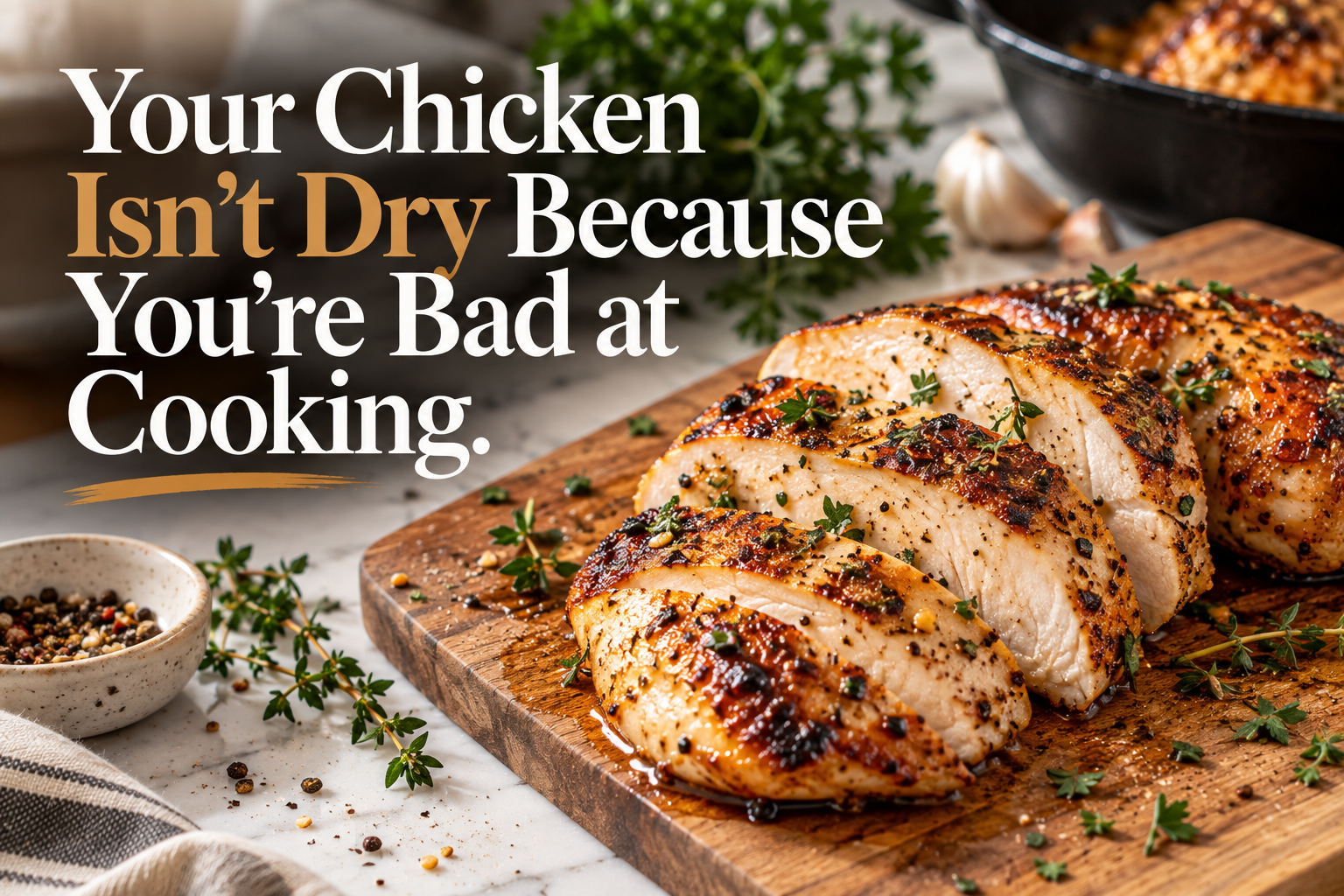
Your Chicken Isn’t Dry Because You’re Bad at Cooking.
Forks247 • The Test Kitchen
Dry chicken gets blamed on the cook all the time. But most of the time, the real problem is much simpler: the chicken stayed on the heat longer than it needed to.
There is a particular disappointment that comes with cutting into a beautifully seasoned piece of chicken only to discover that it is dry. You did everything else right. You seasoned it. You heated the pan. You let it brown. Maybe you even followed the recipe exactly. And somehow you're still chewing through a chicken breast that feels like it needed a glass of water before you did.
The immediate reaction is usually: I can't cook chicken. That's probably not the problem. Chicken isn't especially difficult to cook. It is simply less forgiving when we treat every piece of it the same.
The Chicken Didn't Forget How to Be Juicy
Chicken contains water naturally. As it cooks, its proteins tighten and moisture begins to move out of the meat. Some of that is exactly what we want. Cooking changes the texture, develops flavor, renders fat, and makes the chicken safe to eat.
But heat doesn't suddenly stop working once the chicken reaches the texture you wanted. Leave it cooking and those proteins continue tightening, pushing out more moisture. Eventually, the difference between juicy chicken and dry chicken can be just a few extra minutes.
That's why adding more marinade, sauce, seasoning, or butter doesn't always solve the problem. You can't season your way out of overcooking.
Breasts and Thighs Are Not the Same Ingredient
One of the easiest ways to improve chicken is to stop treating chicken as if it were one single cut of meat. Different parts of the bird contain different amounts of fat and connective tissue, which means they respond differently to heat.
Chicken Breast
Breast meat is relatively lean. There isn't much internal fat helping protect it as it cooks, which means its window between cooked and overcooked can feel surprisingly small. That doesn't make chicken breast bad. It just means you need to pay attention to temperature instead of assuming more cooking time automatically makes it better.
Chicken Thighs
Thighs contain more fat and connective tissue. They generally tolerate longer cooking and can actually benefit from additional time because heat helps soften that connective tissue. That is one reason thighs work so well for braises, slow cooking, roasting, and other methods where the meat spends more time exposed to heat.
Same bird, very different cooking behavior.
Cooking time should be treated as a guide, not the final authority. Thickness, starting temperature, cookware, cooking method, and the actual heat of your stove or oven can all change how quickly chicken cooks.
The Clock Can't See Your Chicken
A recipe might tell you to cook chicken for six minutes per side. That's useful information, but the recipe doesn't know whether your chicken breast is half an inch thick or nearly two inches thick. It doesn't know whether your skillet is cast iron or stainless steel, whether your burner runs hot, or whether your chicken went into the pan cold from the refrigerator.
Those variables matter. This is why experienced cooks eventually stop asking only, “How many minutes?” They start asking, “What is happening to the food?”
Your Thermometer Is Not an Admission of Defeat
There is a strange idea in home cooking that skilled cooks should be able to touch a piece of meat and magically know exactly what is happening inside. Experience can absolutely teach you visual and tactile cues, but an instant-read thermometer gives you information that guessing cannot.
For chicken, USDA food-safety guidance identifies 165°F as the safe minimum internal temperature. The important part is knowing where you're measuring. Insert the thermometer into the thickest portion of the meat and avoid pressing the probe against bone, which can give you a misleading reading.
That single habit can eliminate a lot of the guesswork that leads people to cook chicken “just a little longer to be safe.” That extra insurance is often where juicy chicken disappears.
Then There's Carryover Cooking
Removing chicken from the pan doesn't mean all cooking activity stops instantly. The exterior of the meat is hotter than the center. After the chicken leaves the heat, some of that energy continues moving inward. That's carryover cooking.
How much the internal temperature changes depends on the size and thickness of the piece and the cooking method, so there isn't one magic number that applies to every piece of chicken. The larger lesson is simple: the chicken is still changing after you remove it from direct heat.
If you wait until it is already far beyond where you wanted it before taking it out of the pan, resting won't undo that.
Resting Isn't Just Something We Do to Steak
Give the chicken a few minutes before slicing it. Resting gives the temperature inside the meat time to become more even and allows the cooking process to settle before you cut into it. Slice immediately and you also lose the opportunity to see what carryover heat was going to do.
This is especially important when you're learning. Cook. Measure. Rest. Cut. Then pay attention to the result. That's how you start connecting temperature to texture instead of memorizing another set of minutes.
High Heat Isn't the Enemy Either
Sometimes people respond to dry chicken by turning the heat way down. That isn't automatically the answer. Heat creates browning, and browning creates flavor. A properly heated skillet can give chicken a beautiful crust without drying out the center—as long as you stop cooking when the chicken is done.
The goal isn't avoiding heat. The goal is controlling it. For thicker pieces, that might mean developing color in the pan and then finishing more gently. For thinner pieces, it might mean a shorter cook altogether. Technique changes with the food in front of you.
- Check the cut. Breast and thigh meat cook differently.
- Check the thickness. Uneven pieces won't finish at the same time.
- Check the heat. Browning is good; uncontrolled heat isn't.
- Check the temperature. Use an instant-read thermometer instead of guessing.
- Remember carryover cooking. Heat continues moving through the meat after it leaves the pan.
- Let it rest. Give the chicken a few minutes before slicing.
And No, More Sauce Isn't the Fix
A great sauce can make chicken taste incredible. It can add acidity, richness, sweetness, spice, or moisture to the plate. But sauce shouldn't have to rescue the meat underneath it.
The better goal is juicy, properly cooked chicken plus a great sauce. That's a very different eating experience from dry chicken covered in something wet.
Stop trying to prove chicken is done by cooking it longer. Learn the cut, pay attention to thickness, control your heat, use a thermometer, and account for what happens after the chicken leaves the pan.
The goal isn't to become better at guessing. The goal is to need less guessing in the first place.
Take It Into the Kitchen
Learn the Skill Behind the Recipe.
Recipes tell you what to cook. Understanding heat, temperature, timing, seasoning, and technique helps you recognize what the food needs—even when you're cooking without a recipe.
Explore Kitchen StudioOne Last Thought
If you've been making dry chicken for years, you probably don't need a more complicated recipe. You need better information while you're cooking.
Learn what the cut can handle. Watch the heat. Check the internal temperature. Give the meat time to rest. Then remember what happened.
Because the difference between dry chicken and juicy chicken isn't some secret chef trick. It's knowing when to stop cooking.
— Chef David
Keep Cooking With Forks247
Keep building your skills, trying new recipes, and understanding the technique behind better cooking.
Keep Cooking.
Your next great meal starts here. Discover chef-led recipes, practical kitchen inspiration, and new ways to bring flavor to your table.
Explore Recipes
Find your next meal, discover new ingredients, and bring something different to your table.
Find Your Next Meal → STORIESExplore the Blog
Chef-led stories, practical cooking advice, seasonal inspiration, and a little food for thought.
Read More Stories → THE CHEFMeet Chef David
Meet the chef behind Forks247 and discover the experience, perspective, and philosophy behind the food.
Meet Chef David →Good Cooking Is About Understanding Why.
Ever wonder why certain techniques work, why ingredients behave differently, or how chefs build layers of flavor?
That's where Kitchen Studio comes in.
Recipes show you what to make. Kitchen Studio helps you understand why it works.
Explore Kitchen Studio →






Follow Us

A chef’s rule worth wearing.
The Taste It Before You Trust It T-Shirt takes one of the kitchen’s simplest lessons and turns it into a statement. Bold typography paired with a refined editorial accent gives the design a clean, modern look that feels just as good outside the kitchen as it does behind the line.
Finished with subtle Forks247 branding on the sleeve, this tee is made for cooks, food lovers, and anyone who knows the final decision should always come down to flavor.
Detail
Premium unisex fit 100% combed and ring-spun cotton Heather colors contain polyester Fabric weight: 4.2 oz./yd² (142 g/m²) Pre-shrunk fabric Side-seamed construction Shoulder-to-shoulder taping Forks247 sleeve branding Designed for everyday comfort
Taste it. Adjust it. Trust yourself.