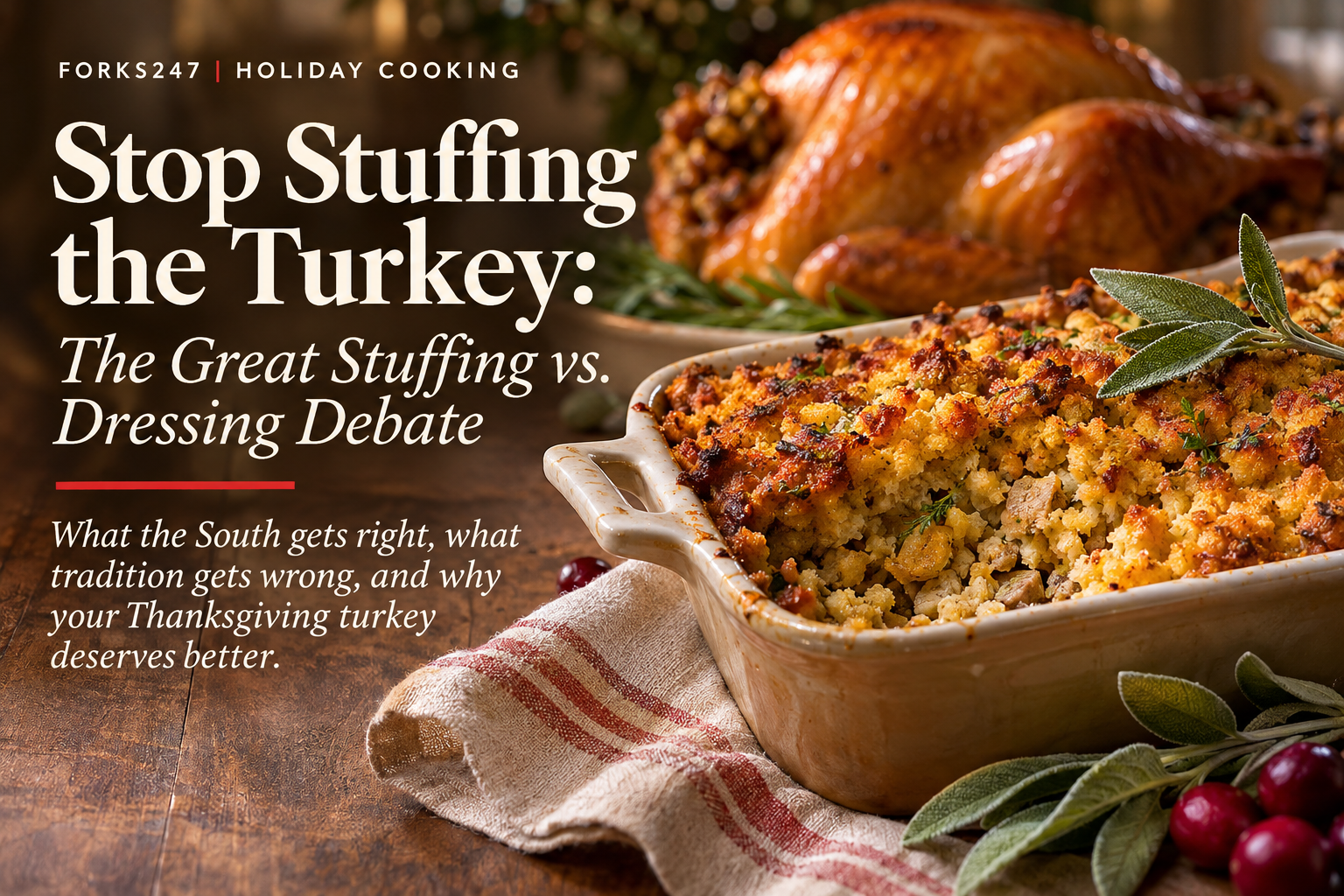
What the South gets right, what tradition gets wrong, and why your Thanksgiving turkey deserves better.
Thanksgiving is approaching, and somewhere across America, a family argument is already brewing. Not about politics, who's bringing the macaroni and cheese, or why somebody's cousin insists on showing up with a store-bought pie and calling it homemade.
No, this particular disagreement has been going on for generations.
Is it stuffing or dressing?
And while we're at it, why are we still putting perfectly good bread inside a raw turkey?
Now, before somebody's grandmother comes looking for me with a wooden spoon, hear me out.
I'm not here to disrespect anybody's Thanksgiving traditions. Some of our favorite holiday dishes have been passed down through generations, and those recipes deserve their place at the table.
But as a chef, I also believe that understanding why we cook something a certain way is just as important as knowing how.
And when it comes to stuffing, dressing, and the Thanksgiving turkey, we've got a few things to discuss.
First, Let's Settle the Name Debate
Depending on where you grew up, the words stuffing and dressing might mean completely different things.
Across much of the South, dressing is practically a Thanksgiving institution. Cornbread dressing, in particular, holds a special place at the holiday table. It's rich, savory, generously seasoned with sage and other herbs, and often made with a combination of cornbread, vegetables, broth, and sometimes sausage, oysters, or other seafood.
Head into other parts of the country, and you're more likely to hear the word stuffing. Bread cubes, onions, celery, butter, herbs, and stock come together in countless variations.
Traditionally, stuffing describes a mixture placed inside poultry or another food before cooking, while dressing is prepared separately.
Simple enough, right? Well, not exactly.
Regional traditions don't always follow culinary definitions. Plenty of families call it stuffing even when it's baked in a casserole dish. And in Southern kitchens, you could put dressing inside the turkey, take it back out, and somebody would probably still call it dressing.
And frankly, I'm not interested in arguing with somebody's grandmother over what she calls her cornbread.
At least not before dessert.
Now, About Putting That Stuffing Inside the Turkey…
Here's where I might lose a few people.
I don't believe the inside of your Thanksgiving turkey is the best place to cook your stuffing.
There. I said it.
I understand the reasoning. Stuffing cooked inside the turkey absorbs some of those flavorful juices, creating a savory mixture that has become synonymous with Thanksgiving.
In theory, it sounds wonderful.
But from a culinary standpoint, we're asking two very different foods to cook together while reaching the proper temperatures at different rates.
And that's where things get complicated.
The USDA recommends cooking stuffing separately for better food safety and more even cooking. When stuffing is placed inside the turkey, the center of that stuffing must reach a minimum internal temperature of 165°F.
The challenge is that your turkey breast may be perfectly cooked before the stuffing reaches that temperature.
So what happens?
You keep roasting. And roasting. And roasting.
Meanwhile, that beautiful turkey breast you've spent the morning seasoning, buttering, and checking every twenty minutes is slowly surrendering its moisture.
By the time everything reaches the proper temperature, you may have a safely cooked stuffing and a turkey breast that requires three ladles of gravy just to make it through dinner.
And nobody wants to explain that to the family after spending half the day in the kitchen.
But my question is simple:
Dressing Deserves Its Own Baking Dish
Let's talk about what happens when you stop treating dressing like something that needs to hide inside a turkey.
First, you gain control.
When dressing is prepared separately, you can manage the moisture, seasoning, temperature, and texture without worrying about what's happening inside the bird.
You can develop a beautifully golden surface while keeping the interior soft, savory, and full of flavor.
And those crispy edges? That's not an accident. That's one of the best parts.
A properly prepared dressing should have contrast. You want a little browning on top, a moist interior that holds together without turning gummy, and enough seasoning to make every bite interesting.
Too much broth, and you've made bread pudding without the dessert. Too little, and you've created something better suited for patching drywall.
Neither belongs on my Thanksgiving table.
The key is balance.
Build flavor from the beginning with sautéed onions, celery, garlic, butter, herbs, and a well-seasoned stock. Taste and adjust the mixture before adding any raw eggs or poultry ingredients. Then allow the oven to create that beautiful contrast between the surface and the center.
If your family enjoys the flavor of turkey drippings, there's nothing stopping you from incorporating properly cooked drippings or flavorful turkey stock into your dressing.
You can still capture that traditional holiday flavor without making the turkey responsible for cooking an entire side dish.
And Please, Don't Underestimate the Cornbread
Now, I can't have a conversation about Thanksgiving dressing without talking about cornbread.
Southern cornbread dressing is a dish with personality.
Cornbread brings its own texture, flavor, and character to the table. Depending on how it's prepared, it can offer a slightly crumbly structure that absorbs broth beautifully while maintaining a richness that traditional white bread doesn't always provide.
But the cornbread itself matters.
If it's overly sweet, it can shift the entire flavor profile. If it's too fresh and moist, the finished dressing may become heavy or overly soft.
I prefer cornbread that has had time to dry out slightly, allowing it to absorb the seasoned broth without completely losing its structure.
And don't be afraid to build on tradition.
Oysters, shrimp, crab, smoked sausage, roasted mushrooms, apples, toasted pecans, and dried cranberries can all bring something different to the table.
Not necessarily together, of course.
We're making dressing, not emptying the refrigerator before the relatives arrive.
The point is that dressing gives you room to explore flavor while respecting the foundation of the dish.
Tradition Is Important. So Is Knowing When to Evolve.
One of the things I appreciate most about holiday cooking is its connection to family.
Recipes carry memories. A familiar aroma can take you back to childhood, a grandparent's kitchen, or a Thanksgiving dinner you haven't thought about in years.
That's powerful.
But preserving tradition doesn't mean we're required to repeat every cooking method exactly as it was practiced fifty years ago.
We have better access to food-safety information, a deeper understanding of cooking techniques, and more opportunities to explore ingredients than ever before.
And sometimes, a small adjustment can make a familiar dish even better.
For me, cooking dressing separately isn't about abandoning tradition. It's about respecting the ingredients, understanding the cooking process, and creating the best possible result.
If your grandmother made legendary stuffing inside the turkey every Thanksgiving, I'm not suggesting you erase her legacy.
I'm simply suggesting that you might be able to recreate those same beloved flavors in a baking dish.
And perhaps give the turkey a fighting chance in the process.
Two Ways to Bring Something Different to the Table
This Thanksgiving, I'm leaning into two approaches that show just how versatile dressing can be.
Southern Seafood Cornbread Dressing
A savory Southern-style dressing built around golden cornbread, aromatic vegetables, herbs, and seafood. Think shrimp and crab folded into a flavorful dressing with a tender interior and lightly browned top.
It's a beautiful way to take a holiday classic and give it a coastal Southern influence without losing its identity.
View the Southern Seafood Dressing Recipe →Harvest Apple, Cranberry & Herb Dressing
For a different direction, imagine toasted bread, sautéed apples, dried cranberries, onions, celery, sage, thyme, and toasted pecans coming together in one baking dish.
The apples bring gentle sweetness, the cranberries add a tart contrast, and the herbs keep everything grounded in those familiar Thanksgiving flavors.
View the Harvest Dressing Recipe →The Final Word From My Kitchen
Whether you call it stuffing, dressing, or that one side dish your family refuses to let anybody else prepare, Thanksgiving food should be about more than following a recipe.
It should be about flavor, technique, tradition, and the people gathered around the table.
My preference?
Let the turkey be the turkey. Let the dressing develop its own beautiful crust.
And let the gravy do what gravy is supposed to do: bring everything together, not rescue a culinary emergency.
Now, I know somebody reading this has been stuffing turkeys for thirty years and has absolutely no intention of stopping.
That's fine. I respect the dedication.
I just hope you own a good food thermometer.
From My Kitchen to Yours
Thanksgiving cooking is about more than recipes. It's about flavor, tradition, technique, and the memories we create around the table.
Whether you're making your grandmother's cornbread dressing or experimenting with something completely new, understanding the cooking process gives you the confidence to make every dish your own.
That's the philosophy behind Kitchen Studio by Forks247, where practical culinary foundations, cooking techniques, and chef-guided resources help you build confidence in the kitchen, meal after meal.
And since we're already discussing Thanksgiving traditions, I have one final question.
Is it stuffing or dressing in your house?
And does it belong inside the turkey, or should it have its own baking dish?
Let's settle this Thanksgiving debate. Or at least make the family group chat a little more interesting.
Happy cooking, and Happy Thanksgiving!
Chef David Wilmott
Executive Chef | Forks247
Food safety guidance: USDA Food Safety and Inspection Service — Stuffing and Food Safety .
Keep Cooking.
Your next great meal starts here. Discover chef-led recipes, practical kitchen inspiration, and new ways to bring flavor to your table.
Explore Recipes
Find your next meal, discover new ingredients, and bring something different to your table.
Find Your Next Meal → STORIESExplore the Blog
Chef-led stories, practical cooking advice, seasonal inspiration, and a little food for thought.
Read More Stories → THE CHEFMeet Chef David
Meet the chef behind Forks247 and discover the experience, perspective, and philosophy behind the food.
Meet Chef David →Good Cooking Is About Understanding Why.
Ever wonder why certain techniques work, why ingredients behave differently, or how chefs build layers of flavor?
That's where Kitchen Studio comes in.
Recipes show you what to make. Kitchen Studio helps you understand why it works.
Explore Kitchen Studio →


Follow Us

A Year Built on Flavor.
Bring inspiration into your kitchen all year long with the Forks247 2027 Culinary Calendar, a thoughtfully curated celebration of seasonal ingredients, inspired recipes, and everyday culinary excellence.
Created by Chef David and the Forks247 Kitchen Studio, this calendar brings together beautiful food imagery, chef-inspired cooking ideas, and seasonal highlights designed to make every month a little more flavorful.
Whether you're a passionate home cook, a food enthusiast, or simply someone who appreciates great food, this calendar is your invitation to explore, create, and enjoy the flavors of every season.
What's Inside
- 12 Months of Culinary Inspiration:A full year celebrating the ingredients, flavors, and traditions of each season. - 12 Featured Recipes:Chef-curated dishes showcasing seasonal ingredients and approachable culinary techniques. - Seasonal Ingredient Highlights:Discover ingredients at their best throughout the year. - Chef's Notes:Practical kitchen insights and inspiration from Chef David. - Culinary Celebrations:Explore food-related occasions and seasonal traditions. - Digital Recipe Access:Scan the featured QR code to discover the calendar's companion recipes online.
More Than a Calendar
The Forks247 Culinary Calendar is designed to inspire creativity beyond the page. From comforting winter favorites to vibrant summer dishes and holiday entertaining, each month offers another opportunity to bring something delicious to the table.
Perfect for your kitchen, home office, workspace, or as a thoughtful gift for the food lover in your life.