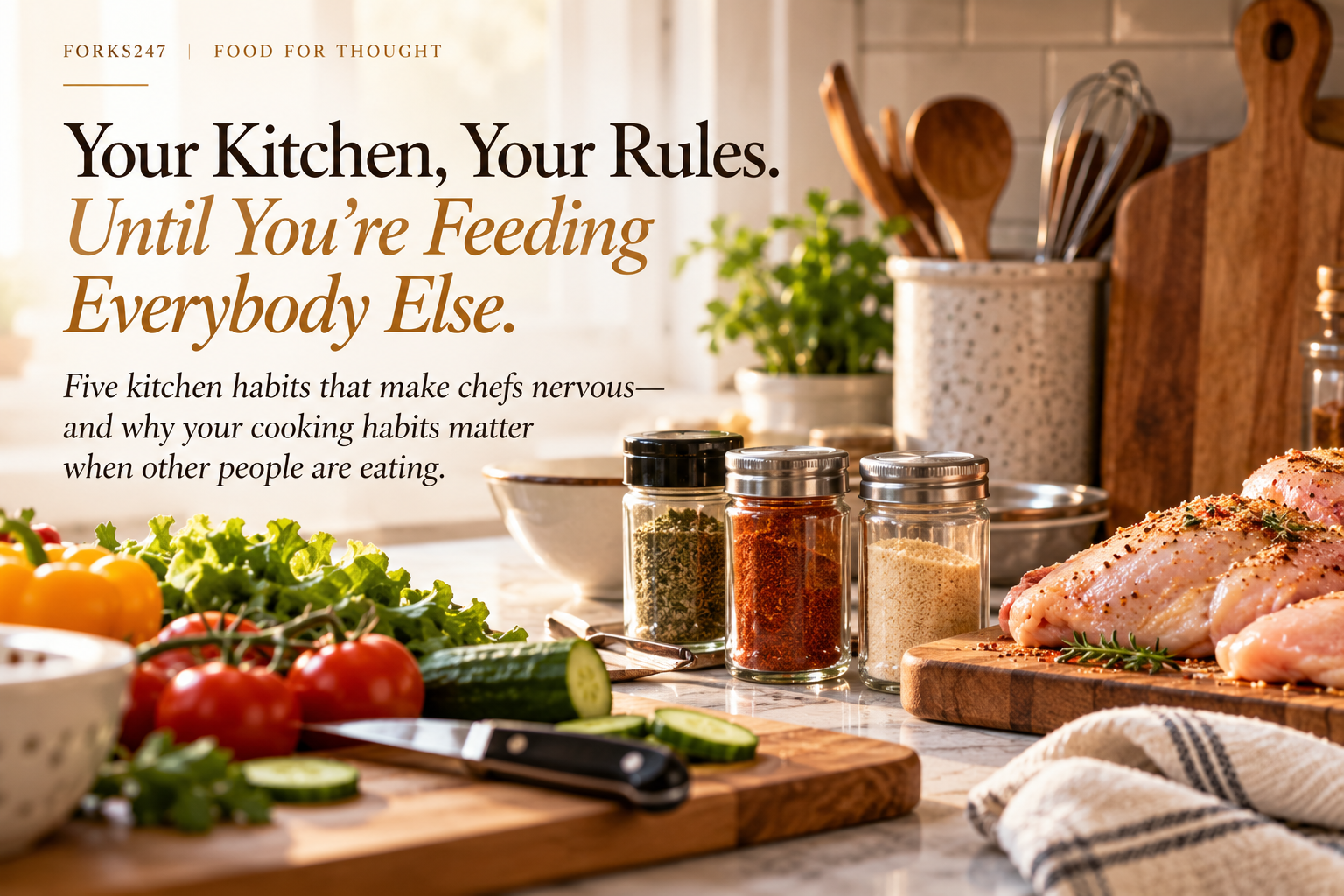
Five kitchen habits that make chefs nervous—and why your cooking habits matter when other people are eating.
Every home has its own rules.
Some people don't allow shoes in the house. Others don't mind. Some people wash dishes immediately after dinner. Others believe those dishes need a little time to sit in the sink and reflect on their decisions.
And then there are the people whose pets have unrestricted access to every square inch of the kitchen.
Now, before the cat lovers gather their legal representation, let me explain.
Today is National Cat Day, and while the internet is celebrating our furry little friends, I want to talk about something that doesn't get nearly enough attention: what happens when our personal kitchen habits affect the food we prepare for other people?
Because there's a difference between cooking dinner for yourself and preparing a dish that twenty people are expected to eat at the company holiday potluck.
And as a chef, I can assure you that some of the things people consider perfectly normal in their home kitchens would have me shutting down a cooking station immediately.
Five Kitchen Habits That Make Chefs Nervous
Touching Seasoning Bottles After Handling Raw Meat
Oh, this one right here.
You're preparing chicken for dinner. You've got your garlic powder, onion powder, paprika, and favorite seasoning blends lined up on the counter.
You reach into the bowl, rub the seasonings into the raw chicken, turn a few pieces over, then grab the garlic powder because you think it needs a little more. Then the paprika. Then the onion powder.
Then you open the refrigerator, grab the butter, and adjust the stove. All without washing your hands.
Congratulations. You've just seasoned the entire kitchen with raw chicken juice.
And the worst part? Those seasoning bottles are going right back into the cabinet, where you'll grab them tomorrow while preparing something completely different.
Here's something worth knowing: A published food safety study found evidence of cross-contamination on 48% of the spice containers sampled during an experiment involving raw ground turkey.
Forty-eight percent! That's not a seasoning blend I want anything to do with.
A little preparation prevents a lot of problems.
Allowing Pets on Food Preparation Surfaces
Since it's National Cat Day, we might as well address the elephant—or should I say the tabby—in the room.
I have seen entirely too many videos of cats walking across kitchen countertops, sitting beside mixing bowls, drinking from sinks, and supervising dinner preparations like they're waiting on a paycheck.
And the owners think it's adorable. "Look at my little sous chef!"
Ma'am. Fluffy may be family, but Fluffy did not pass the food handler certification.
Now, I'm not suggesting that everyone with a cat has an unsanitary kitchen. Plenty of pet owners maintain excellent cleaning habits. But let's discuss reality.
Pets walk on floors, explore questionable places, shed hair, and carry microorganisms on their paws and fur. Cats also use litter boxes, which makes allowing them onto food preparation surfaces especially concerning.
Your pet doesn't have to look dirty to introduce contamination. And just because you're comfortable with your cat sitting next to the cutting board doesn't mean your dinner guests share that comfort.
Love your pets. Absolutely. But they don't need a reserved seat next to the macaroni and cheese.
Tasting Food and Putting the Same Spoon Back in the Pot
We've all seen it. Somebody is standing over a pot of spaghetti sauce.
They grab a spoon, take a taste, nod approvingly, and put the spoon right back into the sauce. A few minutes later, here comes that same spoon again.
Another taste. Another stir. Another trip to the mouth.
At this point, that spoon has more frequent-flyer miles than a business traveler.
And before someone says, "Well, it's my kitchen!" That's wonderful. But are you the only person eating?
Because if you're preparing dinner for guests, nobody signed up for a community saliva exchange program.
Even when cooking for yourself, using clean tasting utensils is a better habit. Once other people are involved, it's especially important.
Professional kitchens taste food constantly. That's how we adjust seasoning and balance flavor. The difference is that we don't keep returning the same spoon to the food.
And no, wiping it on your apron doesn't count as cleaning it.
Using the Same Cutting Board for Raw Meat and Fresh Produce
Picture this. Someone places raw chicken on a cutting board, trims it, cuts it into pieces, and transfers it to a bowl.
Then, without properly washing and sanitizing the board, they grab a cucumber and start preparing the salad.
Excuse me? Since when did the garden salad become a chicken dish?
This is one of the easiest ways to introduce cross-contamination into a meal.
Raw meat and poultry can carry harmful bacteria. When those bacteria transfer to ready-to-eat ingredients, such as lettuce, tomatoes, cucumbers, or fresh herbs, there's no guarantee that another cooking step will eliminate the danger.
And rinsing a contaminated cutting board with a quick splash of water isn't enough.
Personally, I prefer an organized cooking station where everything has its place. Raw proteins in one area. Vegetables in another. Clean utensils ready to go.
Because preparing a meal shouldn't feel like you're navigating a biological obstacle course.
Leaving Food Sitting Out for Hours
Here comes another holiday favorite.
The Thanksgiving spread is ready at noon. Everybody eats.
Then people start watching football, playing cards, having conversations, and going back for second helpings.
By five o'clock, the macaroni and cheese is still sitting on the table, the turkey hasn't been refrigerated, and somebody's auntie is telling everyone the food is fine.
"We do this every year!" Well, that doesn't mean we should.
Tradition does not make bacteria less ambitious.
Food safety isn't determined by how delicious something smells, how much seasoning you used, or how many generations have been preparing a dish the same way.
Temperature matters.
According to USDA guidance, harmful bacteria can multiply rapidly between 40°F and 140°F, commonly called the temperature danger zone.
Hot foods should be held at 140°F or higher, and cold foods should remain at 40°F or below.
Perishable food shouldn't sit at room temperature for more than two hours—or one hour when temperatures exceed 90°F.
And here's another thing: reheating food doesn't necessarily undo every problem caused by improper storage.
Because "it still smells good" is not an approved food safety measurement.
Cleanliness Isn't About Appearances
Here's where I want to make something clear.
An expensive kitchen doesn't automatically mean a sanitary kitchen. Neither does a spotless countertop, a beautiful set of cookware, or a pantry organized well enough to impress the internet.
I've seen people focus so much on how their kitchens look that they overlook how they actually handle food. And that's the distinction.
You can't see every harmful microorganism. You can't always smell contamination. And you certainly can't determine whether food is safe simply because somebody tells you they made it with love.
Love is wonderful. But love doesn't replace soap, proper sanitation, or temperature control.
As a chef, I believe good cooking is about more than flavor. It requires discipline, awareness, and respect for ingredients. That same respect should extend to the people eating the food.
The Holiday Potluck Problem
Now that we're approaching Thanksgiving, Christmas, and the season of office parties, church gatherings, and family dinners, this conversation becomes even more important.
When you prepare a dish for a group, you're taking on a responsibility.
You may be feeding children, older adults, pregnant guests, or people with medical conditions that make foodborne illness particularly dangerous.
And most of those people won't have any idea what happened in your kitchen before that casserole arrived on the buffet table.
They don't know whether you washed your hands after handling raw chicken. They don't know whether your cat was sleeping beside the mixing bowl. They don't know whether the food sat in your car for three hours before you brought it inside.
They're trusting you. And that trust deserves more than "Don't worry, it's fine."
Now, I'm not suggesting that we interrogate everybody who signs up for the holiday potluck. Although, depending on what I've seen on social media, a few people might benefit from a short questionnaire.
I'm simply saying that when you're cooking for others, your personal habits shouldn't compromise someone else's health.
Good Cooking Starts Before the First Ingredient Hits the Pan
One of the things I emphasize as a chef is that cooking begins long before the heat comes on.
It starts with preparation. How you organize your ingredients. How you handle raw proteins. How you maintain your workspace. How you store food. And how you move through your kitchen without creating unnecessary risks.
These aren't complicated restaurant secrets. They're basic habits that anyone can develop.
You don't need professional-grade equipment or a culinary degree to practice proper kitchen sanitation. You just need to be intentional.
And perhaps give Mr. Whiskers a comfortable place to sit that isn't next to the cutting board.
Final Thoughts
At the end of the day, what you do in your own kitchen is your decision. But when you invite other people to your table—or bring food to theirs—the responsibility changes.
Food should bring people together, create memories, and give us something to enjoy. Not send everybody home wondering whether the potato salad was worth the risk.
So this holiday season, let's put a little more thought into the way we prepare and serve our food.
Wash your hands. Keep your cooking surfaces clean. Prevent cross-contamination. Pay attention to temperature.
And please, for the sake of everybody attending the office potluck, stop touching the garlic powder after rubbing down raw chicken.
Good food starts with good habits. And the people you're feeding deserve both.
Happy National Cat Day.
What's one kitchen habit you've witnessed that made you immediately lose your appetite?
Was it someone handling raw meat and touching everything in sight? Pets roaming across kitchen counters? The infamous double-dipping tasting spoon? Or something even worse?
Drop it in the comments.
And cat owners, don't worry. You're welcome in this conversation, too. Just leave Fluffy off the countertop.
Keep Cooking.
Your next great meal starts here. Discover chef-led recipes, practical kitchen inspiration, and new ways to bring flavor to your table.
Explore Recipes
Find your next meal, discover new ingredients, and bring something different to your table.
Find Your Next Meal → STORIESExplore the Blog
Chef-led stories, practical cooking advice, seasonal inspiration, and a little food for thought.
Read More Stories → THE CHEFMeet Chef David
Meet the chef behind Forks247 and discover the experience, perspective, and philosophy behind the food.
Meet Chef David →Good Cooking Is About Understanding Why.
Ever wonder why certain techniques work, why ingredients behave differently, or how chefs build layers of flavor?
That's where Kitchen Studio comes in.
Recipes show you what to make. Kitchen Studio helps you understand why it works.
Explore Kitchen Studio →




Follow Us

A chef’s rule worth wearing.
The Taste It Before You Trust It T-Shirt takes one of the kitchen’s simplest lessons and turns it into a statement. Bold typography paired with a refined editorial accent gives the design a clean, modern look that feels just as good outside the kitchen as it does behind the line.
Finished with subtle Forks247 branding on the sleeve, this tee is made for cooks, food lovers, and anyone who knows the final decision should always come down to flavor.
Detail
Premium unisex fit 100% combed and ring-spun cotton Heather colors contain polyester Fabric weight: 4.2 oz./yd² (142 g/m²) Pre-shrunk fabric Side-seamed construction Shoulder-to-shoulder taping Forks247 sleeve branding Designed for everyday comfort
Taste it. Adjust it. Trust yourself.